










Halifax House Price Index – April 2026
House prices remained broadly stable in April
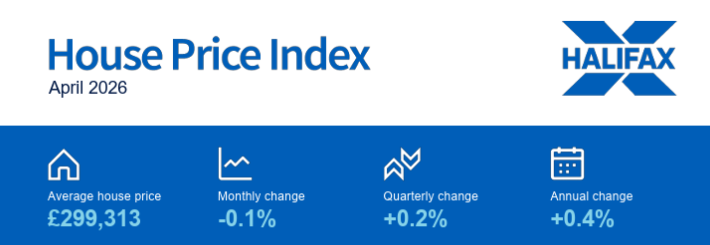
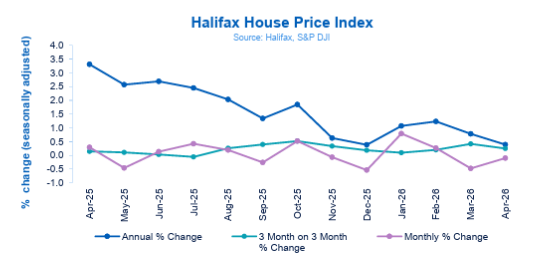
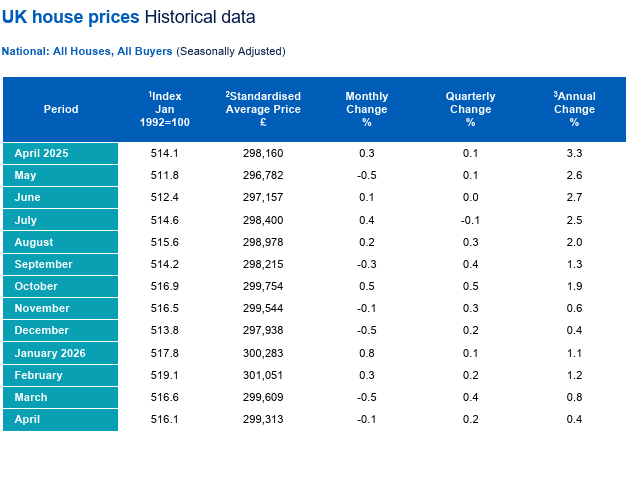
- House prices edged down -0.1% in April, following a -0.5% fall in March
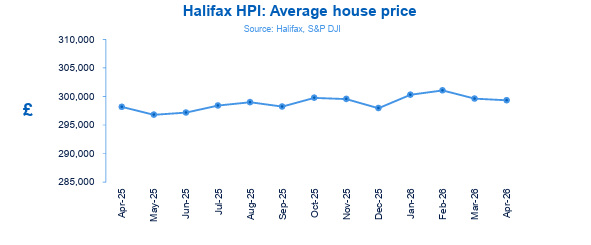
- Average property price now £299,313, compared with £299,609 in March
- Annual growth slowed to +0.4%, from +0.8% in March
- Northern Ireland continues to record the strongest annual growth at +7.6%
Amanda Bryden, Head of Mortgages, Halifax, said:
“Average house prices showed little movement in April, edging down by just -0.1% compared to March, with the typical property now costing £299,313. The pace of annual growth also eased to +0.4%.
“After a strong start to the year, recent global developments have added a greater degree of uncertainty to the outlook. In particular, higher energy prices have fed into inflation expectations, prompting markets to reassess the path for interest rates – a shift that has already pushed up borrowing costs for many buyers.
“This understandably leads to more caution among some households, with the cost-of-living once again front of mind and extra thought being given to planned property moves.
Even so, the housing market continues to display the resilience that has been its hallmark in recent years. While activity is likely to cool in the near term, the underlying picture remains one of relative stability, supported by wage growth that continues to outpace house price inflation.
“Another important factor is that the majority of existing homeowners are on fixed-rate mortgages, meaning they are largely insulated from short term changes in interest rates.
“A slower pace of house price growth may be disappointing news for existing homeowners. However, for those looking to step onto the property ladder, stable prices are helpful, even if higher mortgage rates mean affordability remains stretched. The average price paid by first time buyers has fallen slightly to £238,908, its lowest level so far this year.”
Nations and regions house prices
House prices continue to vary significantly by region and nation, with stronger growth in the North and more subdued conditions in the South.
Northern Ireland still leads UK annual house price growth, with average prices up +7.6% over the past year to £224,851. Scotland also recorded strong growth, rising +4.0% annually to an average price of £222,448.
Wales has seen property price growth continue to slow, now +0.7% on annual basis, taking the typical home value to £230,952.
In England, stronger price growth remains concentrated in northern regions. The North East saw prices rise +4.5% over the year to £183,445, while the North West recorded annual growth of +3.4%, with the average home now costing £248,945.
By contrast, the southern markets continue to see prices fall. The South East led declines, with prices down -2.0% year‑on‑year to £383,044, while London saw average values fall by 1.4% to £536,051.
Housing activity
- HMRC monthly property transaction data – UK home sales increased in March 2026. UK seasonally adjusted (SA) residential transactions in March 2026 totalled 104,070 – up by +1.3% from February’s figure of 102,750 (up +15.9% on a Non-SA basis). Quarterly SA transactions (January 2026 to March 2026) were approximately +1.0% higher than the preceding three months (October 2025 to December 2025). Year-on-year SA transactions were 40.9% lower than March 2025 (-39.0% lower on a non-SA basis). (Source: HMRC)
- Latest Bank of England figures show the number of mortgages approved to finance house purchases increased in March 2026 by +1.3% to 63,531. Year-on-year the figure was -0.8% below March 2025. (Source: Bank of England, seasonally-adjusted figures)
- The March 2026 RICS Residential Market Survey points to a further softening in housing market activity as geopolitical and economic uncertainty continues to weigh on sentiment. New buyer enquiries weakened materially, with the net balance falling to -39% from -29% in February, the weakest reading since August 2023. Agreed sales also declined sharply, dropping from -13% to -34%, reflecting reduced demand. New instructions moved into negative territory at -6%, indicating a modest slowdown in new listings. (Source: Royal Institution of Chartered Surveyors (RICS) monthly report).
Kindly shared by Halifax