










Halifax House Price Index – May 2026
House prices steady in May despite broader market uncertainty.
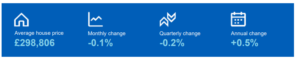
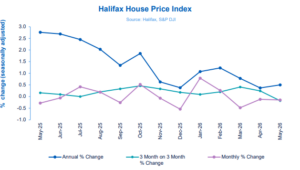
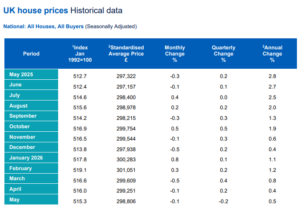
- House prices edged down -0.1% in May, following a similar -0.1% fall in April
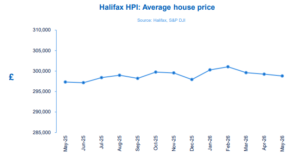
- Average property price now £298,806, compared with £299,251 in April
- Annual growth up slightly to +0.5%, from +0.4% in April
- Northern Ireland continues to record the UK’s strongest annual growth at +7.8%
Amanda Bryden, Head of Mortgages, Halifax, said:
“Average house prices remained broadly stable in May, with a slight fall of -0.1% matching that seen in April. The typical property now costs £298,806, while the pace of annual growth edged up slightly to +0.5%.
“Property price trends continue to reflect the uncertainty linked to developments in the Middle East. Despite recent cuts to mortgage rates, higher inflation expectations have kept borrowing costs above the level seen at the start of the year, continuing to stretch affordability for many buyers and temper demand.
“Even so, overall activity has held up well, reflecting the underlying resilience of the UK housing market. Latest industry figures show transaction levels remain relatively stable, suggesting buyers and sellers are still moving.
“Among first-time buyers, annual growth is more subdued at +0.3%. While getting onto the property ladder remains a big challenge, there has been increasing support from lenders, including more flexible affordability checks and a growing range of low-deposit options.
“Looking ahead, borrowing costs and consumer confidence are likely to continue shaping activity in the coming months, with house prices expected to remain broadly stable while interest rates stay elevated. The housing market remains closely tied to wider global developments, with a return to sustained house price growth dependent on an improvement in the inflation outlook and a fall in mortgage costs.”
Nations and regions house prices
As has been the case for many months, property prices continue to vary significantly by region and nation, with stronger growth in the North and more subdued conditions in the South.
Northern Ireland continues to lead UK annual house price growth, driven by a limited supply of available properties, along with relative affordability compared to some other regions. Average prices are up +7.8% over the past year to £227,177, which is the highest rate of growth in the last six months, Scotland also recorded strong annual growth, now at +3.8% with an average price of £222,650.
Wales has seen property price growth continue to slow, now +0.1% on annual basis, taking the typical home value to £230,355.
In England, stronger price growth remains concentrated in northern regions. The North East saw prices rise +3.1% over the year to £181,703, while the North West recorded annual growth of +3.0%, with the average home now costing £248,304.
By contrast, southern markets continue to see prices fall. The South East led declines, with prices down -2.1% year-on-year to £382,704, while London saw average values fall by -1.5% to £534,375.
Housing activity
- HMRC monthly property transaction data – UK home sales fell in April 2026. UK seasonally adjusted (SA) residential transactions in April 2026 totalled 101,030 – down by -3% from March’s figure of 103,910. Quarterly SA transactions (April 2026 to June 2026 provisionally) were approximately +1.0% higher than the preceding three months (January 2026 to March 2026). (Source: HMRC)
- Latest Bank of England figures show the number of mortgages approved to finance house purchases increased in April 2026 by +3.1% to 65,945, the highest level since January 2025. Year-on-year the figure was +9.0% above April 2025. (Source: Bank of England, seasonally-adjusted figures)
- The April 2026 RICS Residential Market Survey reflects a challenging macroeconomic environment, with rising interest rate expectations dampening buyer demand. New buyer enquiries remained negative at ‑34% in April, though slightly improved from March (‑40%). Agreed sales were largely unchanged at ‑36% (vs. ‑35%), while new instructions increased slightly to ‑3% (from ‑6%), signalling limited fresh supply to the market. (Source: Royal Institution of Chartered Surveyors (RICS) monthly report).
Kindly shared by Halifax