










Lloyds House Price Index – September 2026
House prices hold steady despite impact of higher interest rates

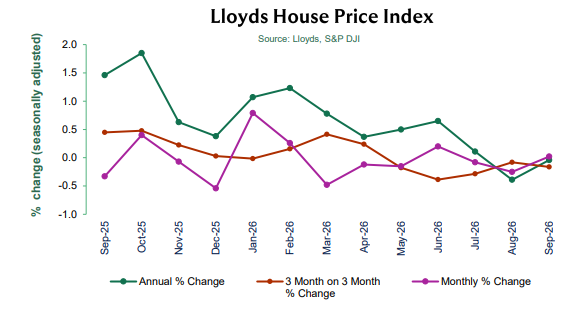
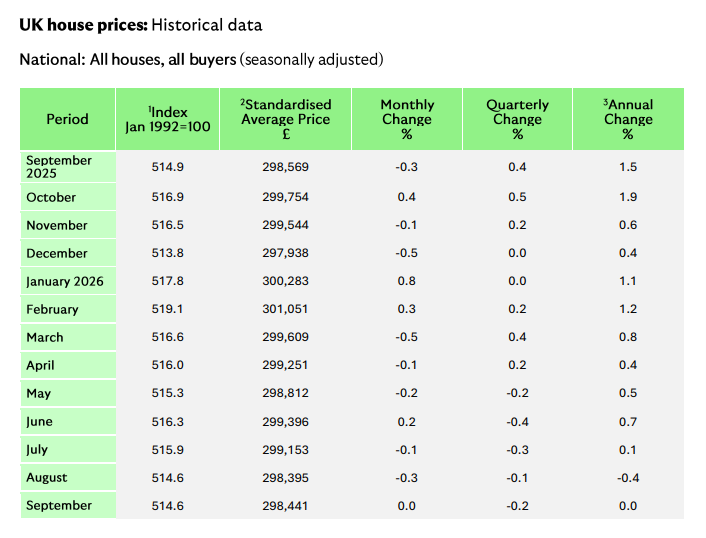
- House prices were unchanged in September (0. 0 %), following a -0. 3% fall in August
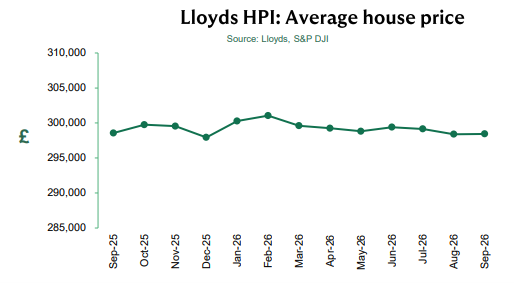
- The average property price is now £298,4 41, compared to £29 8 ,395 in August
- Prices were also unchanged annually (0.0%) compared with September last year
- Northern Ireland continues to lead UK annual growth , at + 7.4%
Andrew Assam, Mortgages Director at Lloyds, said:
“UK house prices were unchanged in September (0.0%), following a -0.3% fall in August. The average property now costs £298,441, while annual growth also remained flat at 0.0%.
“While the market overall has been fairly subdued, property prices have so far proved resilient during a period of higher mortgage rates, which has been driven by changing expectations around the future path of Base Rate. That’s mirrored in wider economic data, with household spending holding up better than many expected despite energy and other cost pressures arising from the Middle East conflict.
“Whether that picture continues is likely to depend on how confident consumers feel that the latest cost‑of‑living pressures will prove temporary. Confidence has long been a key driver of housing market activity, and will play an important role in shaping demand over the remainder of this year and into 2027.
“For now, the housing market appears to be balancing buyer caution with continued underlying demand. While higher mortgage rates and wider economic uncertainty are encouraging some people to take a more measured approach, new enquiries from prospective buyers are now at their highest since February. That should help sustain activity in the near term, with any movement in house prices likely to remain modest.”
First -time buyers and new Your First Home scheme
The average UK first -time buyer property price was broadly unchanged in September at £236,779, up marginally from £236,568 in August. However, this remains below the record high of £241,244 reached in February.
Saving for a deposit remains one of the biggest barriers to homeownership for many first -time buyers. New measures, such as the Government’s recently announced Your First Home scheme for eligible new -build properties in England, alongside the growing availability of low -deposit mortgage products from lenders, could help more aspiring homeowners take their first step onto the property ladder sooner.
While the scheme has been announced, full eligibility criteria, income caps, local property price caps and implementation details are not expected to be confirmed until the Budget in October.
Nations and regions house prices
Northern Ireland continues to lead the UK, with annual house price growth increasing to +7.4 % from 6.8% last month. The average property value has also reached a new record high of £231,917.
Scotland continues to post solid growth, with prices up +3.4% over the past year to an average of £223, 330. Growth has also strengthened in Wales, rising to +1.2%, with the typical property now valued at £231,287.
In England, the strongest annual growth remains in the north. The North East recorded growth of +2. 4 %, taking the average property price to £184,546, while the North West saw prices rise + 1.9% to £248,932.
The West Midlands was the only other English region to see positive annual growth, at +0.8%, with the average property value of £260,892.
By contrast, house prices remain under pressure across much of southern England, where higher average property values continue to present a greater affordability challenge.
Greater London recorded the largest annual decline, down -2.2% year -on -year to £ 531,548, closely followed by the South East, down -2.1% to £ 380,829. Prices in Eastern England fell -1.6% to £330,151.
Housing activity
- UK residential transactions fell by -1.5% to 95,220 in August 2026 on a seasonally adjusted basis (provisional estimates). On a non -seasonally adjusted basis, transactions declined by -10.6% over the month. In the three months to August, transactions were -3.9% lower than in the preceding three months, while volumes were -1.9% below August 2025 levels on a seasonally adjusted (SA) basis. (Source: HMRC)
- Bank of England data shows mortgage approvals for house purchases fell to 54,918 in August 2026 , down -1.8% month -on -month and -16.0% lower than a year earlier , suggesting some further softening in housing market activity. (Source: Bank of England, SA figures)
- The latest RICS UK Residential Market Survey for August 2026 showed activity indicators becoming less negative but remaining relatively weak. New buyer enquiries improved to a net balance of -19%, from -26% in July, while newly agreed sales rose to -17%, from -28%. New instructions increased to a net balance of zero, from -2% previously. Overall, the survey suggests housing market activity remains subdued, although demand and sales have continued to recover gradually from recent lows. (Source: Royal Institution of Chartered Surveyors (RICS) monthly report).
Kindly shared by Lloyds